
Algebra
Enter and Calculate with Matrices on a TI-84
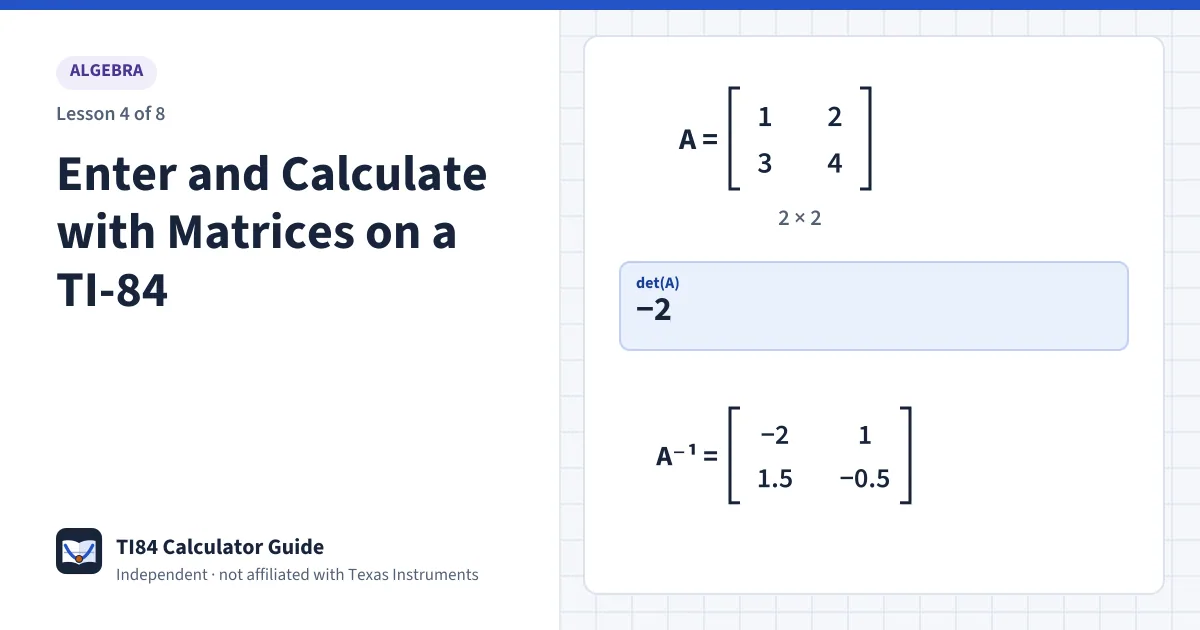
Set matrix dimensions, enter values, and compute A×B, det(A) = −2, A⁻¹ = [[−2,1],[1.5,−0.5]] and Aᵀ for A = [[1,2],[3,4]], with dimension rules explained.
Type at least two letters.
Independent practice tool · free · runs in your browser
Enter matrices up to 4 × 4 to add, subtract, multiply, transpose, or find the determinant and inverse. Every cell must contain a number: empty cells are reported, never quietly treated as zero. When sizes do not fit an operation, the tool explains exactly why — for example, that the columns of A must equal the rows of B.
Every cell needs a number; empty cells are reported, never treated as 0. Tab moves between cells.
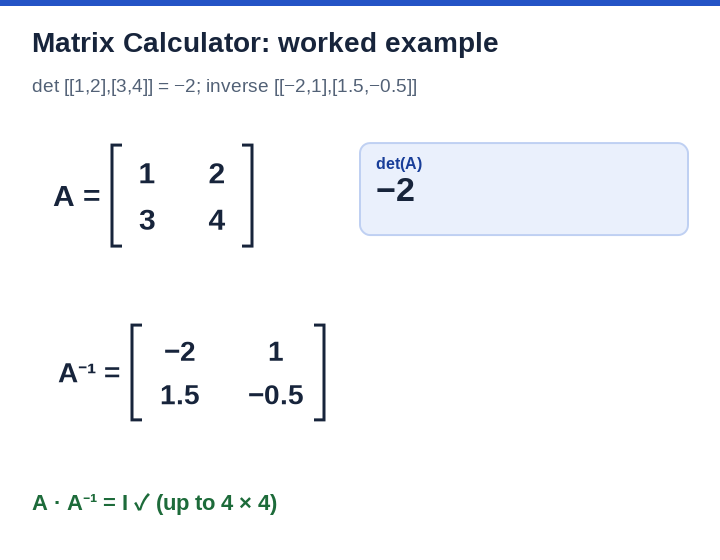
Determinants and inverses use Gaussian elimination with partial pivoting. A matrix is reported as singular when a pivot is no larger than 10⁻¹² × the largest entry × the size, which covers exact singularity and matrices too close to singular for a meaningful inverse. Values within 10⁻¹² of an integer are displayed as that integer.
On a TI-84 you create matrices in the MATRIX ▸ EDIT editor and paste [A] from MATRIX ▸ NAMES. This page does not imitate those menus; the guides below give the verified key sequences.
For A · B the number of columns of A must equal the number of rows of B. A 2×3 times a 3×2 works and gives 2×2; a 2×3 times a 2×2 does not.
A singular matrix has determinant 0 (its rows are linearly dependent), so it has no inverse — for example [[1, 2], [2, 4]].
No. Empty cells are errors, so a typing slip cannot silently change your answer.
TI84 Calculator Guide is independently operated and is not affiliated with, sponsored by or endorsed by Texas Instruments. TI-84 Plus, TI-84 Plus CE and related names are used only to describe the calculators our guides cover.
Set matrix dimensions, enter values, and compute A×B, det(A) = −2, A⁻¹ = [[−2,1],[1.5,−0.5]] and Aᵀ for A = [[1,2],[3,4]], with dimension rules explained.
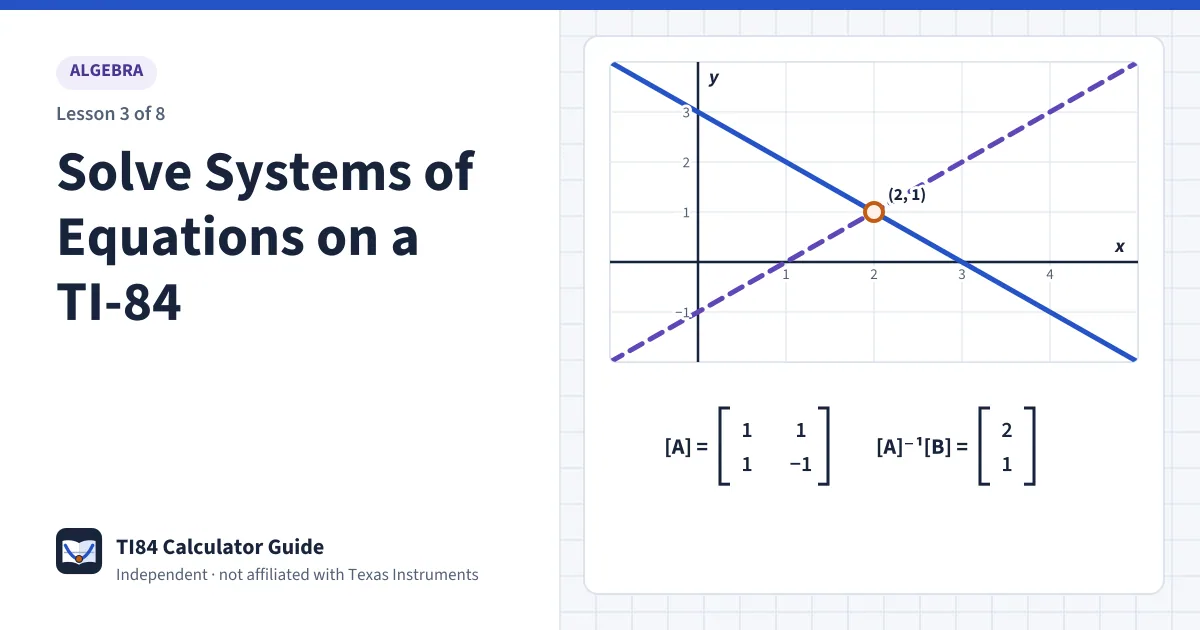
Find (2, 1) for x + y = 3 and x − y = 1 two ways — graph intersection and matrix inverse — and recognize when a system has no solution or infinitely many.
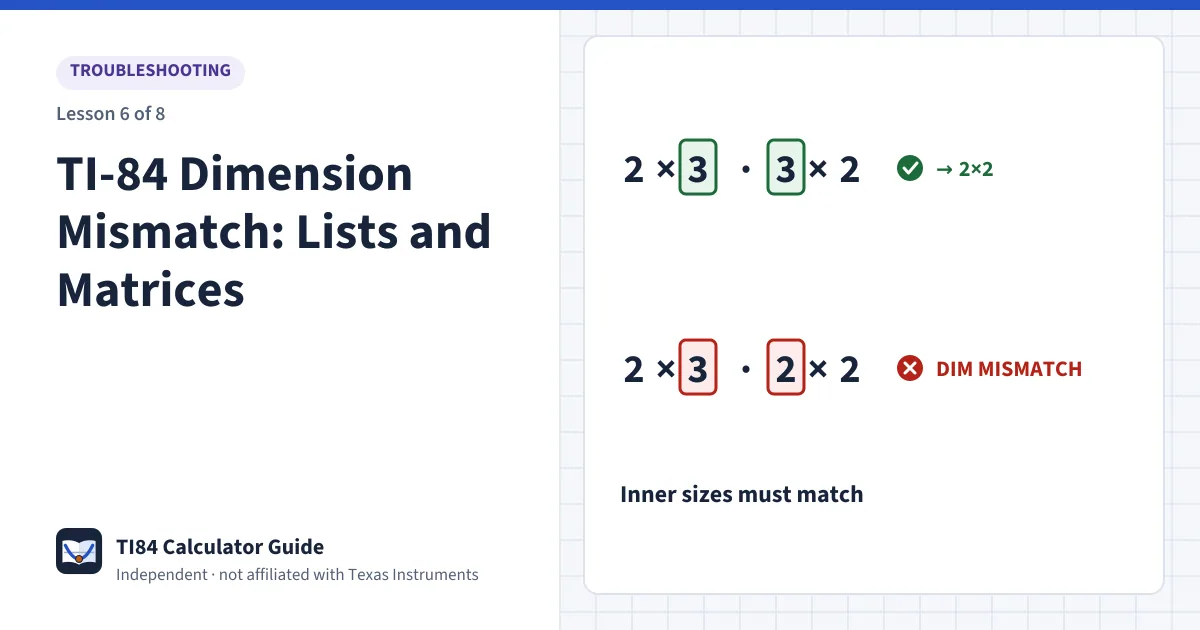
Why a 2×3 times 3×2 product works but 2×3 times 2×2 does not, how unequal L1 and L2 lengths break regressions, and how to repair data without losing pairs.